What Our Customers Are Saying

Lab Diamond Education

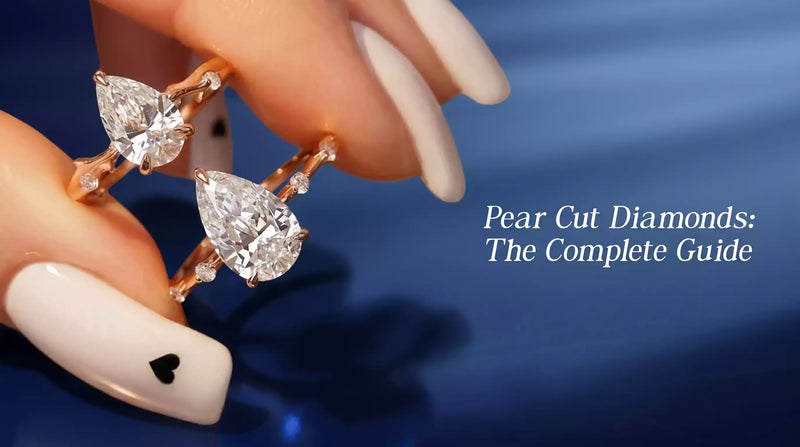
Pear Cut Diamonds: The Complete Guide

• 8 min read

A pear cut diamond, also called a teardrop, combines the round brilliant and marquise into a shape with a rounded base tapering...

Shop Pear Lab Grown Diamonds

Pear shaped lab grown diamonds combine the round and marquise into an elongating teardrop. IGI certified and 50% off, they're distinctive and finger-flattering. Look for point symmetry and a well-cut stone to avoid a bow-tie.

What Is a Pear Shaped Diamond?

A lab grown pear diamond is a brilliant cut with a rounded end and a single point, half round, half marquise. It's also called a teardrop.

Being a brilliant cut, it sparkles like a round. Being elongated, it stretches across the finger and makes the hand look longer. A pear shaped lab grown diamond gives you both.

Which Way Does a Pear Diamond Point?

Traditionally the point faces toward the hand, away from the body. That's how all the pear rings are shaped, set and photographed.

Some prefer the point toward the wrist, and east-west settings turn it sideways. There's no correct answer, only a common one.

What to Look For in a Pear Cut

Three things, in order:

  • Point symmetry. Draw an imaginary line down the center. Both sides should be mirror images, with the tip in dead center. Asymmetry is the most common flaw in a lab grown pear diamond, and the most visible once set.
  • Length-to-width ratio. Aim for 1.45 to 1.55. Below that looks stubby; above gets narrow.
  • Bow-tie. A dark band across the center. It isn't on the grading report, so check the video and see whether the shadow shifts when the stone tilts.

Best Settings to Protect the Point

The point is the vulnerable part of a pear, and it needs a V-prong.

A V-prong wraps the tip, covering it on both sides. Since the tip is the thinnest area of the stone and is exposed without one, chipping occurs there. Beyond that:

  • Solitaire with a V-prong, classic, clean and safe
  • Halo, surrounding stones shield the point and add size
  • Bezel, the most protective if you're hard on your hands
  • Three stone, pears work beautifully as side stones too

Pear Lab Grown Diamond Prices

Most of the time, one-carat pear-shaped lab-grown diamonds range from $250 to $800, but it all depends on color, clarity as well as on cut. Additionally, lab-grown pear-shaped diamonds are less expensive per carat than the round ones, much like ovals. Plus, it seems bigger; a round measures 6.5 mm, and a 1ct pear is around 8.5 × 5.5 mm.

G–H color and VS–SI clarity is the sweet spot. Check the point: color concentrates at the tip, so warmth shows there first.

Pear Lab Grown Diamonds at Precious Carbon

We supplied the diamond trade for over 20 years before selling direct. Every lab grown pear diamond is graded on the 4Cs and ships with its certificate, free shipping and 30-day returns. See our diamond shape guide, or view natural pears.

Frequently Asked Questions

Which way does a pear diamond point?

Traditionally toward the hand, away from the body. It's not mandatory, you can wear it whichever way you prefer.

What should I look for in a pear cut?

Look for a bow-tie shadow in the video after giving priority to point symmetry and a length-to-width ratio of 1.45 to 1.55.

Are pear diamond shapes good for engagement rings?

Yes. They're distinctive and elongate the finger, provided the point is protected by a V-prong setting.

How much is a lab grown pear diamond?

Up to 70% below natural, with 50% off here. Most 1 carat pears fall between $250 and $800.

Can the point of a pear diamond chip?

It can, if left exposed, since the tip is the thinnest part of the stone. A V-prong setting removes most of that risk.

Does a wedding band sit flush against a pear ring?

Often not, because the point extends down the finger. A contoured band designed around the shape fits best.